Art in the Age of Data Centres: Daniel Goldhaber in Conversation
Back in November, I had the pleasure of speaking with filmmaker and director Daniel Goldhaber, as a tie-in with the NFTS Student Action Society’s screening of How To Blow Up a Pipeline (2022, hereafter ‘Pipeline’).
We talk through the political implications of Pipeline, as well as his debut feature Cam (2018), his upcoming remake of Faces of Death, the politics of social media, and much more.
The following conversation has been edited for length and clarity.
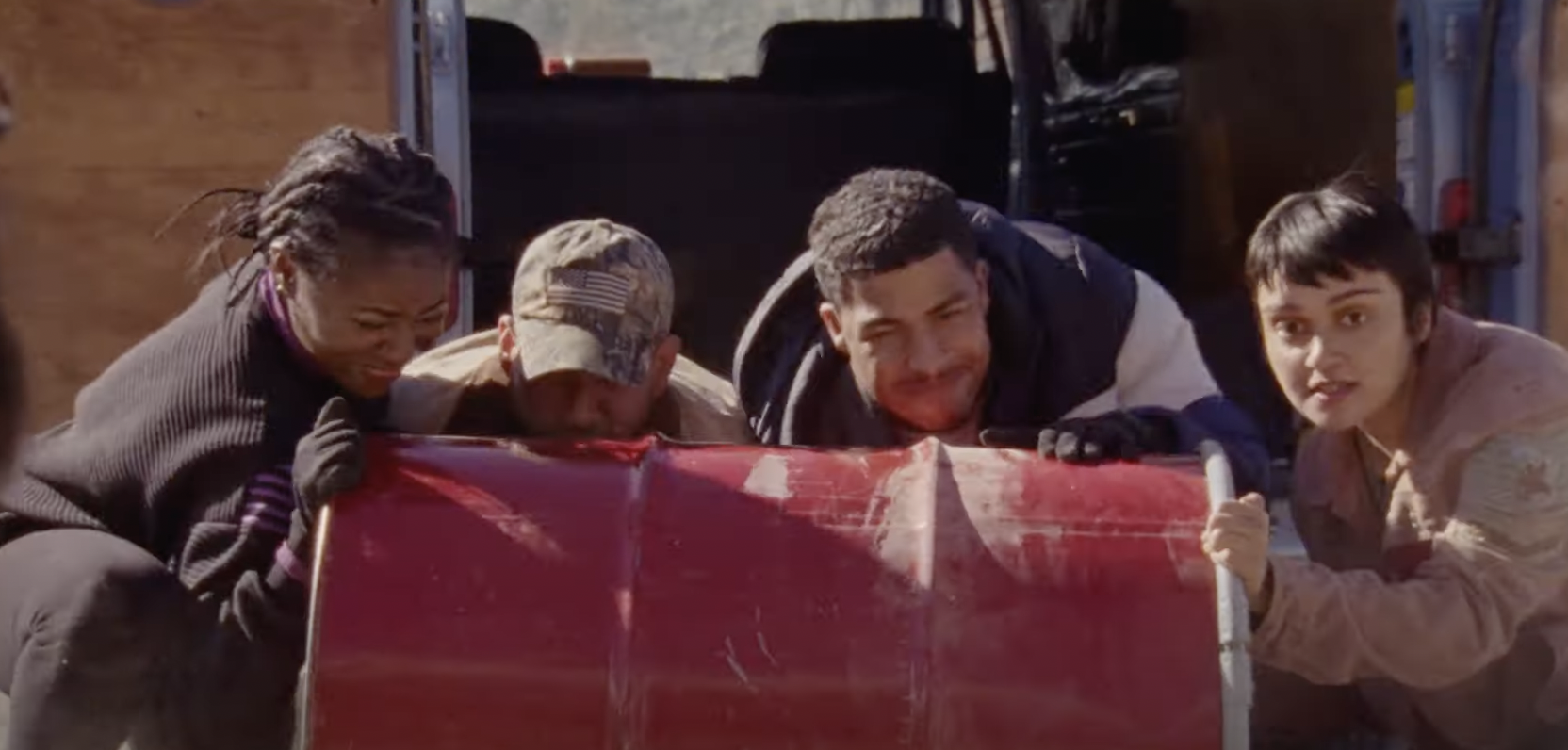
How to Blow Up a Pipeline. dir. Daniel Golhaber. 2022, Neon.
Tom: How are you getting on?
Daniel: I’m good, yeah, just working on some new stuff and getting emotionally ready for the winter…
Tom: l’m very intrigued by your upcoming Faces of Death remake. I didn't know until recently that Charli XCX is attached as well.
Daniel: That movie's actually been done for the better part of a year and a half. It was Charli’s first movie. We cast her a good year before Brat even came out. But there's just been some complications with getting it out into the world. Hopefully we’ll have some concrete updates about that soon.
Tom: I'm very excited. It’ been a crazy time to see her get on so many projects. I'm waiting for The Moment.
Back to you, though! I wanted to ask what your experience was like at Harvard, doing Visual and Environmental Film studies — did you start getting into more and politically reflective filmmaking when you were a student?
Daniel: I actually had quite a challenging experience at Harvard. They have a really great film programme there — it’s very focussed on a “fundamentals of filmmaking” approach. Trying to answer pretty foundational things — what is an image? How do you acquire an image? What is the relationship between image maker and subject? There’s a lot of basis in documentary, but then I think as kind of a training it is helpful when you move into narrative film. So there was not really a sense of “political filmmaking” at Harvard. If there is a kind of political component to the department, I guess it’s about the relationship to a subject that you're representing as an image maker and a filmmaker.
But I think for me, the political journey that I started to take as a filmmaker was more just motivated by my own interest as a person and, citizen and wanting to tell stories that to me felt relevant to world that I live in. After I graduated I continued to find my voice, and I began to feel well-positioned to tell entertaining and genre-fuelled stories about like less commonly embraced, political and social ideas. I dabbled in many other forms of storytelling and narrative. But when I stumbled on Cam and really started pushing forward on that, a lot of other career momentum followed.
Tom: It’s interesting to hear about the genre side of things for you. Going from a web-based horror in Cam to Pipeline is a really interesting change. Would you say you’re into horror?
Daniel: No, I'm not really much of a horror fan at all. Of course, I still like them — and I have a great deal of respect and admiration for horror fans and their communities. But it’s not a world that I come from and it was never my like waypoint into filmmaking. I hadn’t even seen many of the “classic” horror movies until after I had made Cam. I also never saw Cam as a horror necessarily.
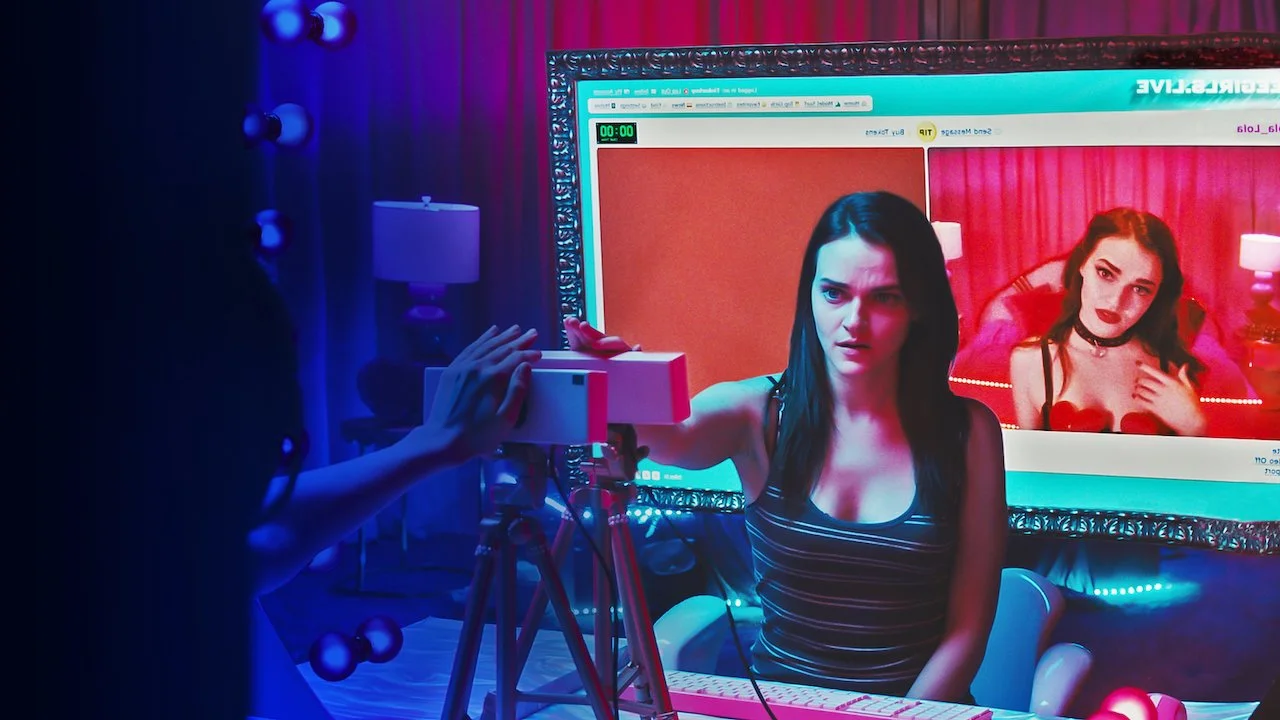
Madeline Brewer in Cam (2018) dir. Daniel Goldhaber. Netflix.
Everything about that movie very naturally emerged from the subject matter. I wanted to explore the cleavage of digital identity writ large — more specifically, the ways that digital identity as a female sex worker is really complicated. This kind of performative femininity suddenly becomes this creature that isn't even you. To me there’s something inherently dissociative and eerie about these other versions of yourself that run around on the internet. Then again, I’d say I was inspired by Lynch and Cronenberg when I was making Cam.
Tom: Definitely — on the Lynch note, I noticed your Sight and Sound top 10 list has Eraserhead on there.
Those questions about digital identity and image-making aren’t going away — they're just getting more complicated. There’s a through line there from the spectacle of sexuality in Cam to that of violence in Faces of Death.
In other ways people often share violence online in the name of making others ‘aware’ of certain issues. There’s a difficult conversation to be had there about the political use of that. The COVID-BLM Twitter days is one example.
Daniel: When it comes to something like BLM and 2020, I think there's there's an even broader question that needs to be asked. What is the value of sharing violent images, as a form of practice, but what is the value of sharing as a form of practice full stop? We're very cutely aware that platforms like X, Instagram and so on have become the predominant driver of the degradation of our culture, our politics, our speech, over the last 10 years. Not to mention being a driver for the rise of the extreme right-wing and fascism. And a lot of that has to do if the ways in which these platforms prioritise engagement.
And I think the problem is, from a design standpoint, they aim to supplant real life with the platform. That’s the whole business model! You end up believing that by participating in this gamified communication platform, you're also participating in real world change. But that's not necessarily really the case, you know? I'm heartened from a political standpoint by some situations — I think the ways that the Zohran Mamdani campaign in New York found a way to translate social media engagement into real world engagement. There's also a very exciting filmmaking component there that I think holds a lot of value. But one of the things that I think definitely we started to explore with Cam was this notion that what's happening online isn't real, but we believe it to be real. And the kind of gap in between those two truths is terrifying.
Tom: Blindboy, the Irish podcaster, has talked a lot about Twitter as the ultimate emotional video game in which you are rewarded for high arousal emotion. You literally get more ‘points’ for expressing yourself in a way that is more outrageous. There’s a lot there about self-sabotaging activity, or transforming our activity into something that doesn't have much meaning. There’s a connection to Pipeline for me, there. I'm finding ways to segue between your films because they have interesting cross-references!
What was your experience of going from the book to the film? How id you first encounter Andreas Malm’s book?
Daniel: So the book was recommended to me by one of my co-writers, Jordan Schol, and I read it in February of 2021, so it was just on the heels of kind of all that happened in 2020, in all that isolation and a sense of political powerlessness. So I read the book I thought, hey, there’s a real movie in here; all these images of kids struggling in the desert with a bomb popped into my head. It felt like a movie that could really entertain and provoke — and one with a decent price point.
Andreas was really useful — the first thing he did was direct us to a bunch of criticism of the book, and argued the movie needed to include that too. And also, to connect us with a lot of activists and actors who are like very meaningfully engaged with this work and we could kind of help us. I think represent the world of the film as accurately as possible.
Tom: I feel that conversation around political activity is really relevant again after the sensation that was One Battle After Another. Something's in the air again — mainstream and representations of political violence and activism somehow resonate, but I'm questioning whether it's because they are purely cathartic, or that they’re at a complete remove from our real lives. How do you see the context of Pipeline in relation to 2025?
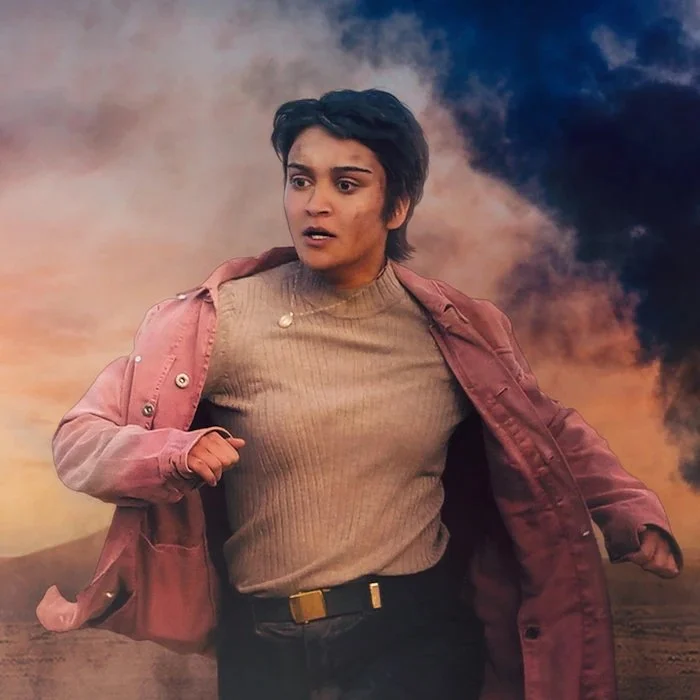
Ariela Barer in How to Blow Up a Pipeline (2022) dir. Daniel Goldhaber. Neon.
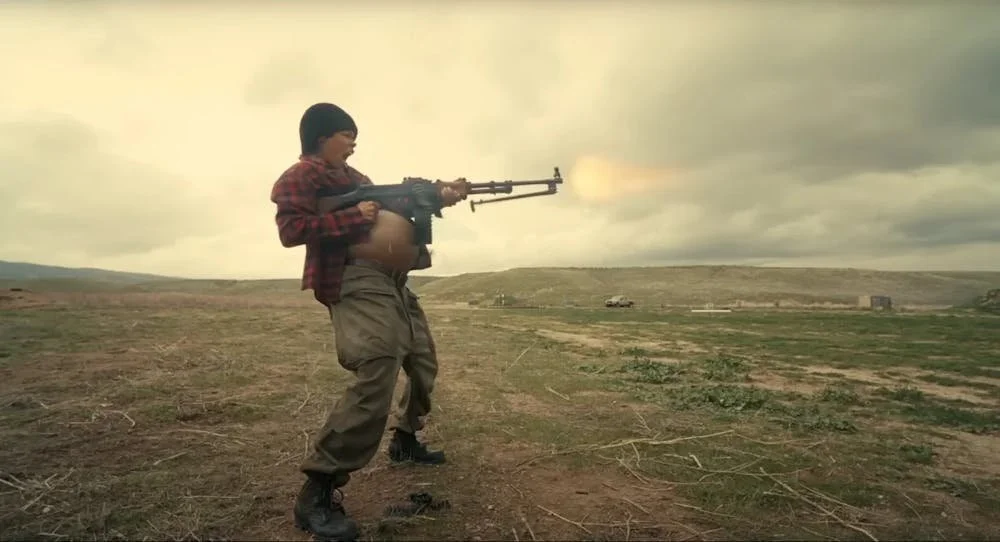
Teyana Taylor in One Battle After Another (2025) dir. Paul Thomas Anderson. Warner Bros.
Daniel: I’ve been going through a kind of reckoning on this, really. We all went through a moment where there was really a belief that taking meaning from movies was tied to some explicit and quantifiable political purpose. I think this was something that internet culture really started demanding as early as 2010. Films, and I guess art objects in general started being put in particular political categories. There was a new demand for the messing and purpose of a film to be really clear. For me, Pipeline was the apex of that kind of filmmaking for myself — like, this film is really doing everything that I've been told a movie needs to do in order to act as a political ‘object’ in an effective way.
Looking at the reaction to the film, we had a really solid month of chatter, in the domestic U.S. cultural space, and then it just went away. A lot of people seemed to come out with some level of false catharsis. It’s easy to feel like you’ve participated in a meaningful act, and leave with a feeling of moral good, despite the fact that all you’ve done is pay for a ticket and watch a movie.
I think art functions better emotionally, when it’s less easy to describe its rhetorical purpose. And that’s reflected in what audiences are embracing and rejecting these days. People don't want art that lectures them. I'm heartened when I see like the success of films like Weapons or Sinners — movies that have both a diversity in representation. And some exciting, provocative political ideas being expressed. But it's not necessarily as obvious as we've been led to believe
On some level I was disappointed by how people reacted to Pipeline. But of course, I’m really happy the movie exists.
Tom: A question I had from a fellow student was on similar lines: given the material — and the variety of characters — of Pipeline, was there any way you thought the film could foster class consciousness? I wonder if there was any activity that you'd seen pop up around the film that you saw as actually meaningful.
Daniel: For me, that’s the wrong question to ask from film and from art. If we’re asking about how a movie can motivate something quantifiable in society, isn’t that just advertising? I have that question in my head especially when that’s what progressive movements start asking from their art. It cheapens the culture of progressivism that allows it to kind of be like rich and human.
But when I look at what's happened to culture writ large, I feel that attitude’s had a negative impact. Culture and politics have swung incredibly far to the right, despite the perpetual focus that we put on film culture, and culture more broadly, having these quantifiable leftist metrics. But also, I think it's been bad for politics at the same time. I would never want to walk away from a movie and say, “hey, did that have an impact”?
Tom: Thank you for your honest answer! This discussion makes me think of 20th century propaganda film, and how some famous agit-prop films, which do have a concrete purpose, have in some way advanced the art of film. But now that we're at a point where there are more ‘accepted’ ways that film exists, which have been established in the past century, it’s interesting to question if there's any place for overt or specific messaging in film. I agree that an audience will tun off very quickly if they feel like they're being preached to — whether that's by the film itself, or by the curator of a film, or broader reception around a film.
Another question was about censorship. You mentioned that there was, a domestic reaction, especially on the part of more right-wing publications about the film “promoting ecoterrorism”. Were you ever kind of actually worried about the reach the film could have because of that?
Daniel: I think to some extent, yeah. We knew we wouldn’t get distribution in Russia, China, or in a lot of the Middle East. But I don't think there was ever like a feeling that the movie would achieve ‘actual’ censorship. That said, there need to be a recognition of the way that censorship operates in the current moment, which is corporate censorship, right? We got picked up by a French distributor, but we could not sell to French television because my French distributor was delicately told that the place where he has his output deal, was owned by a far right-wing guy and this movie wouldn’t fly on the network. That’s really the way that censorship happens these days. We've essentially given up ownership of all of our distribution channels.
It's very, very hard to mass distribute a product by independent means these days, especially a film product, both because there is so much easily readily available corporate content at everybody's fingertips and also because the marketplaces themselves are owned by single corporate entities. Like, if you're going to get your film available to rent globally, you're reliant on Amazon. You're reliant on Apple. And it's very, very easy for those platforms to take the volume knob on your movie and turn it to zero — so it's not coming up in people's recommended feeds, et cetera. I don't want to necessarily say, “ah, yes, that's the reason why Pipeline hasn't had a longer, fuller life on streaming!” It could very much be the quality of the movie. It could very much be that audiences just simply aren't engaging with it for a number of reasons. But what I do know is we faced a lot of challenges getting the movie out into the world, simply because large corporations were not really willing to touch it.
Tom: I was thinking earlier about other changes that have happened in the, more broadly, the environmental activist sphere since Pipeline came out. So, of course, in the UK, we've had lots of activity from groups like Just Stop Oil, and Extinction Rebellion. In Europe, someone like Greta Thunberg has changed from environmental activist icon to someone with a broader political appeal. If you had made Pipeline, like this year or last year, do you feel like would it have been the same movie? What do you think you would have changed in your approach to the story?
Daniel: What would I have changed… that’s tricky! I have a lot of answers to that question. Lots of them come organically from the process of making the film. Once you get into the edit, you see how this stuff is actually operating on an audience now. Then you can start thinking about what you wish you could change, but you can’t. A movie is always a product of a circumstances and its production. It’s always fundamentally limited by how much you know about the material and what your experience is when you set out to do it. So on some level, I'd make a completely different film today.
When people talk about Pipeline on social media, I often see posts like, “man, I wish there was How to Blow Up a Pipeline about data centres!” Right now, that’s where my attention is. What’s interesting about data centres is that the moral case is so much less ambiguous. The moral case about pipelines, about oil, about energy is complicated, because this is stuff that people rely on to live. And to transition away from it is difficult and thorny. And that makes for some interesting questions in the film, but it also makes it a less commercial movie. There’s not an unambiguous “big bad”.
But from my standpoint, there’s absolutely no moral argument for the existence of data centres whatsoever. Not in the way that they exist currently. So I'd probably make a movie about destroying one of those! Like I say, though, my interests and my own political and aesthetic education has evolved a lot in the last four years.
Tom: Yes, I think the conversation has shifted a lot away from individual uses of energy. But at the same time, in filmmaking, there’s a continuing conversation about environmental impact and how many resources we’re ‘taking up’ in production.
Daniel: I think that loops back to the same thing we’ve been interrogating here. How do we handle the ways that we want to place political responsibility on art and art makers? Art can be a very effective reflection of systemic problems in the world, but by and large, it is neither the cause nor solution to those problems. So it's always going to be an effective mirror. But it's critical that we do not mistake it with the thing itself. It’s 100% true that filmmaking is a wasteful industrial endeavour. But it pales in comparison to like the actually problematic wasteful industrial endeavours of our world. And film is not going to become a less wasteful industrial endeavour until our world becomes less wasteful. I think the biggest problem is that people feel like it's really easy to demand change from art and culture. It’s so much harder to demand change from the larger systems of power in which we live.
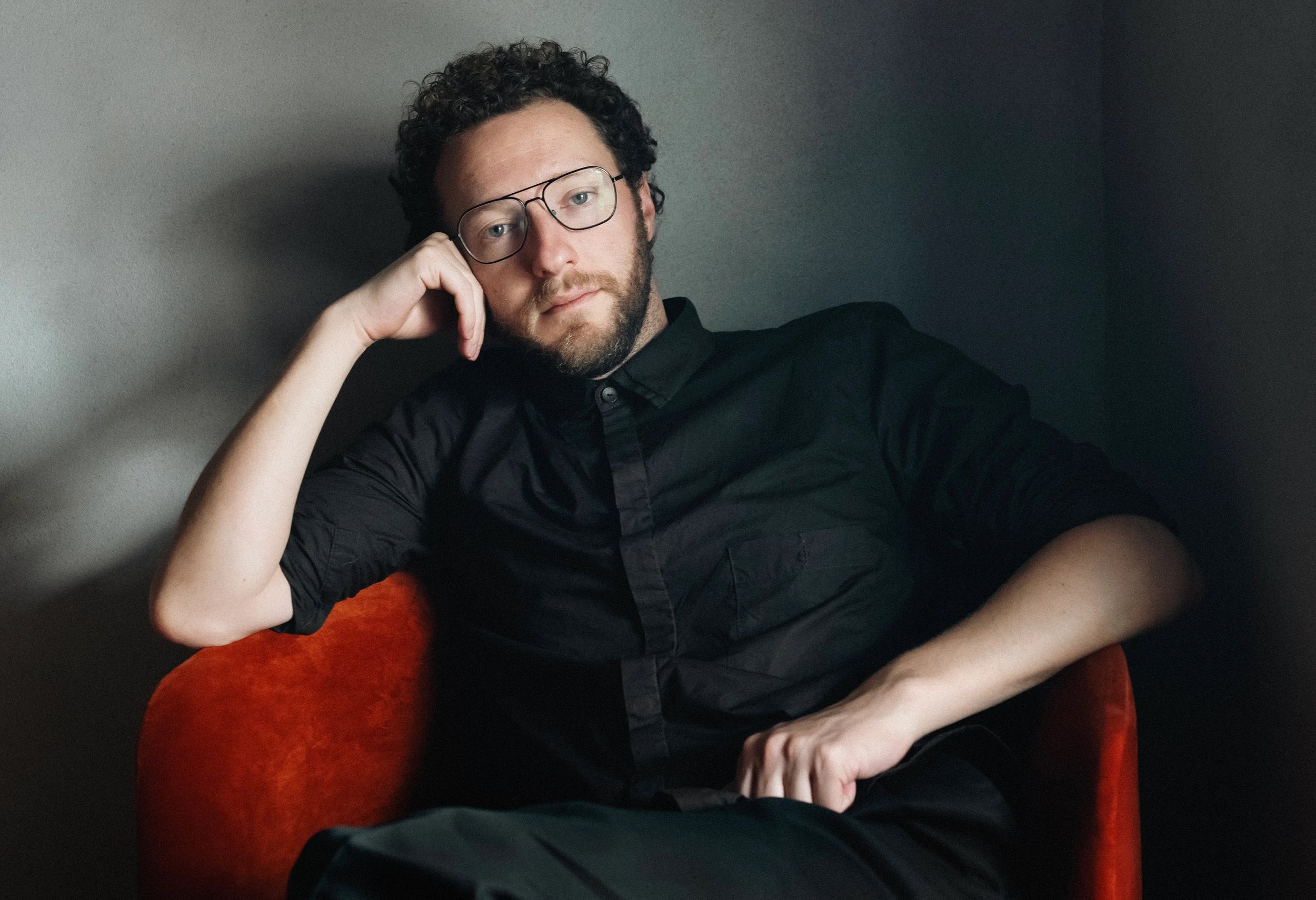
Daniel Goldhaber. Photo credit: Jan Tore Eriksen/NewsLab
Thanks very much to Daniel for collaborating on this article! Be sure to follow him on Instagram here. And stay tuned for news about Faces of Death